
Skip to content

Book a 30-minute call

Scheduling is handled by Calendly, whose privacy policy applies to what you enter. Open in Calendly

Integration and Support Services Portfolio

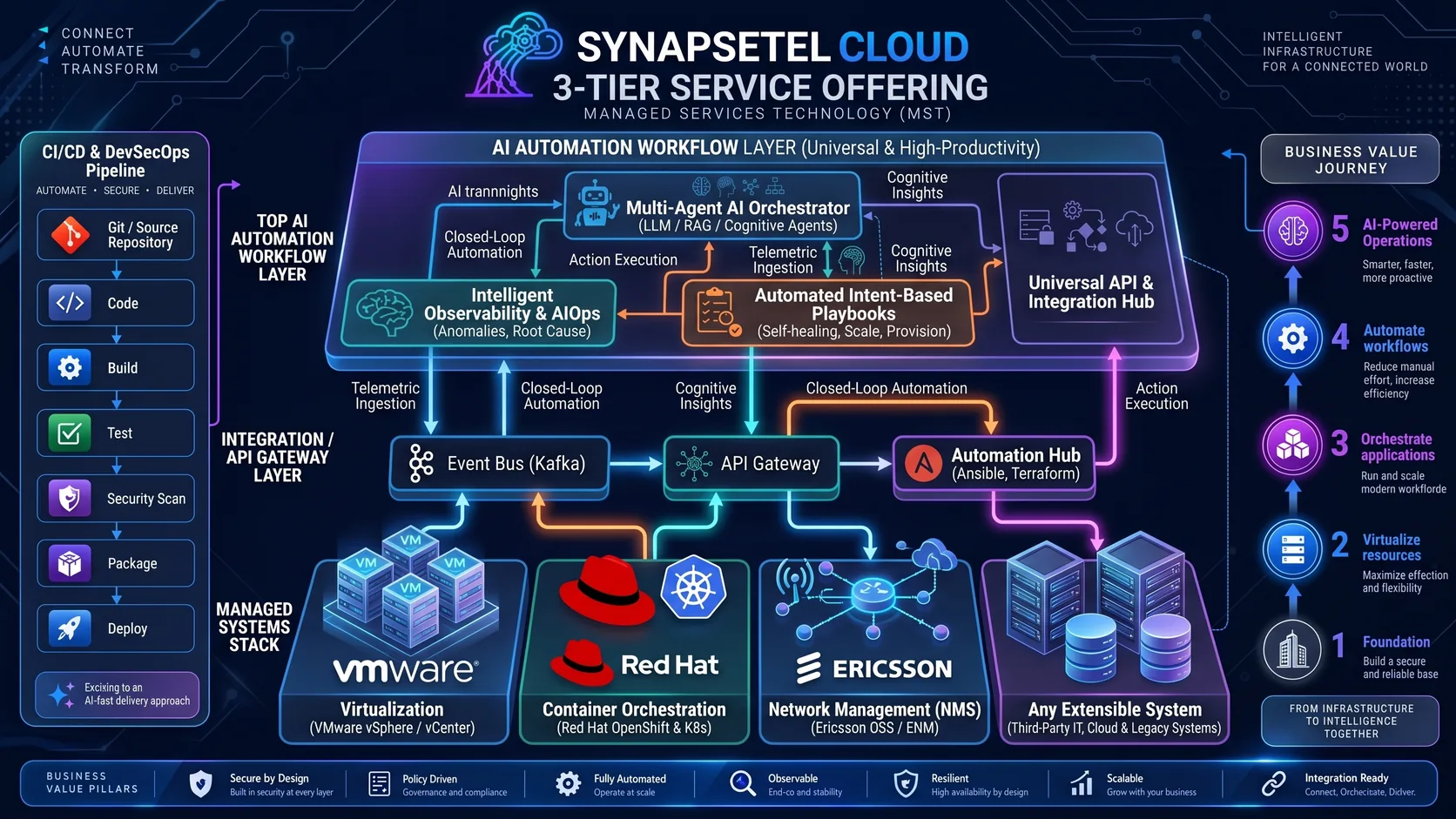
SynapseTel Cloud three-tier service offering diagram: an AI automation workflow layer (multi-agent orchestrator, observability and AIOps, intent-based playbooks, universal API and integration hub) above an integration and API gateway layer (event bus, API gateway, automation hub) and a managed systems stack of VMware virtualization, Red Hat OpenShift and Kubernetes, Ericsson OSS and ENM network management and other extensible systems, with a CI/CD and DevSecOps pipeline on the left and a five-step business value journey on the right.
Use this reference illustration to discuss your environment. It shows possible dependencies and workflows; your engagement scope is agreed separately.

Reference architecture

Where each layer hands off to the next

Network management, platform delivery and operator applications usually fail at their boundaries: a manager upgrade changes an alarm schema, a cluster change fails admission, a portal action changes a backend system. We design and test the three layers as one system.

Connected estate

Three engineering layers with explicit paths for change, network exposure and operational feedback.

T3Enterprise portals, APIs & control planes

  • Next.js / TypeScriptCustomer portals · EN / ES / FR / HT
  • Developer & NOC consolesSelf-service requests · SLO dashboards
  • CAMARA API gatewayQoD · SIM Swap · Device Location
  • Enterprise identityOIDC / RBAC · IdP-managed passkeys

Portal requests → merge request → policy checks → human approval

T2Reviewed delivery & private MCP

  • MCP pre-flightTyped tools · approved model endpoints
  • GitLab CI & policyTrivy · SBOM · Cosign · OPA / Kyverno
  • Protected review & Argo CDHuman approval · GitOps reconciliation
  • Secrets & evidenceVault / ESO · redacted SIEM events

Argo CD → cluster state · CI / IaC runner → hybrid infrastructure

T1Telecom & hybrid infrastructure

  • Ericsson OSS-RC / ENMRAN / Core / IMS management · mediation
  • OpenShift fleetrestricted-v2 · Multus / SR-IOV
  • VMware / vSANConsolidation · MTV → KubeVirt cutover
  • Hybrid infrastructureTerraform / OpenTofu · VMware / Bare-Metal

Network API exposure path

  1. CAMARA gatewayAuthorized customer API requests
    OAuth2 · policy · consent
  2. Consent & exposure adaptersOperator-supported NEF / SCEF interfaces
    Authorized network exposure
  3. 4G / 5G network coreNetwork capabilities · ENM is separate management

Cluster telemetry, pipeline receipts and redacted tool events return to operations consoles and the evidence store.

Reference topologies, not a statement of fit for your estate. Protocol versions, network boundaries, roles and service targets are set in the low-level design during the Assessment Sprint.

01 · T1

Telecom and hybrid infrastructure

We stabilize and migrate Ericsson OSS-RC and ENM environments, build hardened Red Hat OpenShift clusters (restricted-v2 SCCs, Multus CNI, SR-IOV), rationalize VMware vSphere/vSAN storage and run phased workload migrations with rehearsed cutover and rollback.

Stack

Ericsson ENM / OSS-RC · Red Hat OpenShift (OCP) · VMware vSAN & KubeVirt · Terraform & OpenTofu

Infrastructure services

02 · T2

Delivery controls and private MCP

We replace manual release checklists with reviewed GitLab CI and Argo CD pipelines. Schema-restricted MCP agents on private model endpoints draft manifests, run OpenShift readiness checks, apply OPA/Kyverno policy and collect evidence. A person still approves the merge.

Stack

GitLab CI & Argo CD · Private MCP Servers (OpenShift AI / vLLM) · OPA Gatekeeper & Kyverno · HashiCorp Vault

Delivery and MCP services

03 · T3

Enterprise portals, APIs and control planes

We build multilingual operator consoles, internal developer portals and CAMARA-aligned network API marketplaces in Next.js, React and TypeScript, connected to operator-authorized 3GPP SCEF/NEF exposure where it is available.

Stack

Next.js & TypeScript · CAMARA / OpenAPI 3.1 Gateways · 3GPP SCEF / NEF Adapters · OIDC / SAML enterprise auth

Portal and API services
Select a tier
T1Telecom and hybrid infrastructure

Separate management, workload migration and hybrid routing paths, joined by validated platform dependencies.

Telecom management

  1. Ericsson OSS-RCLegacy node inventory · phased retirement
    Phased node re-homing
  2. Ericsson ENMRAN / Core / IMS · REST NBI · cmedit · AMOS
    Northbound telemetry
  3. FM / PM / CM mediation3GPP · SNMPv3 · VES collectors · Kafka

Virtualization & container platform

  1. VMware vSphere / vSANSPBM · I/O baselines · VM dependencies
    Warm / cold migration; final cutover
  2. OpenShift VirtualizationMTV · KubeVirt · ODF / supported CSI
    Runs on the cluster
  3. Red Hat OpenShiftrestricted-v2 workloads · Multus / SR-IOV

Hybrid storage & virtualization

  1. On-premise routingIPAM · segmentation · BGP / BFD where supported
    Hybrid interconnect
  2. vSAN ESA & OpenShift VirtualizationRedundant paths · centralized firewall inspection
    Routed workload access
  3. Hardened cluster foundationOpenShift OCP · restricted-v2 SCCs · ODF · Multi-tenant namespaces · FinOps
Connections across boundaries
Ericsson ENM / Red Hat OpenShift
ENM platform sizing follows the vendor-supported deployment model.
FM / PM / CM mediation / Hardened cluster foundation
Approved telemetry destinations use the defined hybrid routing and security policy.

Southbound element mediation is validated per installed ENM and node software release. MTV warm migrations replicate active blocks in the background and execute final cutover inside a scheduled window with verified ESXi fallback.

Telecom and hybrid infrastructure
T2Delivery controls and private MCP

AI prepares a reviewable change. Deterministic CI checks, protected approvals and runtime admission govern production delivery.

Merge request & bounded MCP tools

  1. GitLab merge requestEngineer commits · Helm / Kustomize / application code
    Webhook / requested review
  2. Pre-flight copilotDraft manifests · readiness report · change diff
    Validated tool calls
  3. Schema-restricted MCP serverTyped tools · server-enforced read-scoped identities

Approved execution boundary

  1. Private model endpointSelf-hosted OpenShift AI / vLLM inside perimeter
  2. Read-only cluster inspectionQuotas · SCCs · current topology; no production mutations
  3. HashiCorp Vault / External SecretsExternal Secrets Operator · controlled runtime access

Deterministic delivery gates

  1. GitLab CI security stageTrivy / Grype · Syft SBOM · Cosign signing
    Build & scan artifacts
  2. Policy validationOPA / Kyverno · SCC compatibility · quotas
    Pass configured checks
  3. Protected human approvalRequired reviewers · branch protections · approved merge

GitOps runtime & evidence

  1. Argo CDApplicationSets · approved desired state
    Reconcile after approval
  2. OpenShift productionAdmission controls · workload RBAC · configured mTLS
    Runtime events & evidence
  3. SIEM & evidence storeRedacted events · attestations · retention policy
Connections across boundaries
Pre-flight copilot / GitLab merge request
Copilot attaches the manifest diff and readiness report for human review.
Pre-flight copilot / Private model endpoint
Model traffic uses an approved private endpoint and processing region.
Schema-restricted MCP server / Read-only cluster inspection
Read-only tool identity can inspect state; it cannot deploy to production.
GitLab merge request / GitLab CI security stage
The merge request starts CI; AI output does not bypass the gates.
Protected human approval / Argo CD
Only the approved merge changes the GitOps desired state.
HashiCorp Vault / External Secrets / OpenShift production
ESO retrieves authorized runtime secrets.
Schema-restricted MCP server / SIEM & evidence store
Redacted tool events are collected under the approved audit policy.
Argo CD / SIEM & evidence store
Sync receipts join build attestations in the evidence store.

MCP servers enforce strict JSON Schema validation and read-only cluster/OSS credentials. Every state change must pass GitLab CI security stages, OPA/Kyverno admission policy and human CODEOWNERS sign-off before Argo CD sync.

Delivery controls and private MCP
T3Enterprise portals, APIs and control planes

Keep customer API exposure distinct from operational change requests and telecom element management.

Experience & enterprise identity

  1. API customers & NOC teamsPartner developers · platform engineers · operators
    HTTPS access
  2. Next.js / TypeScript portalsSandbox · docs · usage metering · operations / SLO views
    SSO & authorization
  3. Enterprise identity & RBACOIDC / SAML · tenant roles · EN / ES / FR / HT

Gateway & capability adaptation

  1. Enterprise API gatewayOAuth2 · mTLS where required · rate limits
    Authenticated API requests
  2. CAMARA API servicesQoD · SIM Swap · Number Verification · Device Location / Status
    Capability & consent mapping
  3. Consent & policy adaptersVersioned OpenAPI schemas · operator authorization · CAPIF where supported

Network exposure & separate management

  1. 3GPP NEF / SCEFOperator-supported N33 / T8 exposure interfaces
    Authorized network access
  2. 4G / 5G core capabilitiesPolicy-authorized network functions
    Separate management interfaces
  3. Ericsson ENM managementSeparate CM / FM / PM integration; not a NEF / SCEF endpoint
Connections across boundaries
Next.js / TypeScript portals / Enterprise API gateway
Portal API traffic enters the authenticated gateway; operational changes use reviewed GitOps requests.
Consent & policy adapters / 3GPP NEF / SCEF
Adapters map only to APIs and versions enabled by the operator.
Enterprise identity & RBAC / Enterprise API gateway
Gateway authorization verifies the caller and tenant policy.

Portal and API gateway requests enforce OIDC/OAuth 2.0 tenant scopes and rate limits at the edge. Southbound 3GPP NEF/SCEF exposure is isolated from ENM element management over dedicated VRFs.

Enterprise portals, APIs and control planes

Checking a GitOps change before deployment

This reference workflow uses Model Context Protocol (MCP) to connect a trusted GitLab job to validation tools. Argo CD keeps the deployment gate.

Read the workflow and code examples

Production reference workflow. Validator tool schemas, OPA Rego policies and RBAC identities are tailored to your cluster and repository topology during onboarding.

  1. GitLab CIReviewed protected revision and rendered workload bundle.
  2. Custom MCP validation serviceRender, live-state diff and admission checks.preflight_validate
  3. Revision-bound reportsourceRevision: … renderSha256: … verdict: pass | fail | unknown

Approved GitOps promotion follows validation.

Argo CDFresh PreSync checks before workload sync.
Kubernetes / Red Hat OpenShiftRollout and application checks follow deployment.

MCP tools operate with read-only cluster credentials; production promotion requires passing CI policy gates, human CODEOWNERS approval and healthy Argo CD PreSync probes.

Demonstration

Synthetic readiness check

A working example of the readiness stage. Enter facts about a synthetic cluster update and the check returns pass, condition and block findings with the rule behind each one. It runs in your browser on the values you type; nothing is sent anywhere.

Demonstration with synthetic input
Load a scenario

Ready to scheduleEvery rule passes on the values entered.

  1. Pass6 workers leave room for one node to drain at a time.
  2. PassThe tightest budget allows 1 unavailable pod(s); drains can proceed.
  3. PassA verified backup 6 hours old is within the 24-hour limit.
  4. PassNo Operator blocks the update.
  5. PassThe 240-minute window covers the 180-minute estimate with rollback margin.
  6. PassA named decision maker can call a rollback during the window.
  7. PassConfiguration matches version control.
Assumptions and limits
  • The rules are generic engineering thresholds, not a vendor compatibility matrix.
  • The check reads no cluster; it evaluates the numbers you enter.
  • A real readiness review adds release compatibility, storage, certificate and licence checks, and is signed off by a named owner.

Interactive MST stack

How the three-tier Managed Services Technology stack fits together

Select a support tier to see where it sits, or step through a scenario to watch telemetry, insights and approved changes move between your estate, the integration layer and the AI automation layer. Every hop names its interface, its change boundary and what lands in your repository.

Where each tier sits

Full MST stack

How the layers interact
Use the left and right arrow keys to step through the scenario.

CI/CD and DevSecOps pipeline

Automate · Secure · Deliver

  1. Git / source repositoryGitLab · merge requests
  2. CodeHelm · Kustomize · IaC
  3. BuildContainer and artifact packaging
  4. TestDeterministic pre-checks and schema validation
  5. Security scanTrivy · Syft SBOM · OPA/Kyverno · Cosign
  6. PackageSigned immutable release
  7. DeployArgo CD GitOps sync and human CODEOWNERS gate

AI automation workflow layer

Universal and high-productivityTier 3 and advanced Tier 2

Integration / API gateway layer

Streaming, routing and executionTier 2

Managed systems stack

Your estate, operated in placeTier 1

Business value journey

From infrastructure to intelligence

  1. AI-powered operationsFaster, more proactive operations with people approving changes
  2. Automate workflowsReduce manual toil and increase delivery velocity
  3. Orchestrate applicationsRun and scale modern workloads reliably
  4. Virtualize resourcesMaximize utilization and cutover flexibility
  5. FoundationBuild a hardened, auditable infrastructure base (lit)
Engineering inspectorStep 1 of 4 · Telemetric ingestionFlow: Telemetric ingestion
Active hop and direction
Ericsson ENM and Red Hat OpenShift (T1) ⇢ Event Bus (Kafka) (T2)
Protocol / interface
3GPP FM/PM/CM mediation · VES collectors · SNMPv3 · Kafka topics
Security and change boundary
Read-only collectors inside your boundary; no subscriber data or production captures leave the estate
Deliverable in your repository
Versioned collector configuration and a topic and schema register in your repository
  • Secure by designBuilt-in security at every layer
  • Policy drivenGovernance and compliance as code
  • Fully automatedOperate deterministically at scale
  • ObservableEnd-to-end telemetry and stability
  • ResilientHigh availability and tested rollback by design
  • ScalableModular growth across your estate
  • Integration readyConnect, orchestrate and deliver